Learn
The Dark Spectrum of Personality
The dark spectrum of personality identifies psychologically plausible yet socially problematic personality types. NeoThymos employs a toxic personality detector to surface and label user designed personalities that may be problematic.
Why a “Dark Spectrum of Personality”?
In any sufficiently detailed model of personality, a seemingly infinite number of personalities can be constructed. Of these, a large percentage will not resemble any psychologically grounded human personality. But among the many that do represent human-like personalities, there are some that psychologists have studied extensively because, while being relatively uncommon, they are “problematic” for the individual or for the human society they inhabit. These psychometrically plausible, yet socially problematic, personality types we refer to as the dark spectrum of personality.
One of the more important contributions of the HEXACO model of personality used in NeoThymos is the addition of the Honesty-Humility domain (Integrity in NeoThymos) which has proven crucial for predicting ethical behavior, cooperation, and importantly, various forms of counterproductive conduct - dark spectrum personalities.
Problematic Personalities
1. The Dark Core
Every pattern described below shares one root, which psychologists often refer to as the dark core: a low score on what we refer to as Integrity in NeoThymos. Integrity is the disposition toward sincerity, fairness, modesty, and a lack of interest in exploiting others for personal gain.
A personality low on these qualities is willing to bend the truth, treat rules as obstacles, and put its own advantage first. On its own this is the common thread; the four patterns that follow are this root combined with a second distinctive ingredient. Nothing is flagged without this root — a sincere, fair, modest personality won’t resemble any of these patterns no matter what its other traits are.
2. Narcissistic
The narcissistic pattern is the dark core paired with boldness and a high sense of self-importance - socially confident, attention-seeking, and convinced of its own superiority. It reads as grandiose and entitled: comfortable taking the spotlight, uneasy sharing credit, and inclined to see itself as exceptional.
Because boldness and social confidence are desirable traits on their own, this pattern only appears when that confidence sits on top of low integrity. A bold, charismatic, honest personality is simply charismatic — not narcissistic.
3. Machiavellian
The Machiavellian pattern is the dark core paired with a cool, calculating, strategic style — patient, unsentimental, and willing to manipulate. Where the narcissistic pattern wants admiration, this one wants advantage: it plans, withholds, and works people and situations toward an outcome, without the impulsiveness of the patterns below.
It’s the “operator” profile — composed and deliberate, which is exactly what makes it effective and what makes it worth flagging.
4. Psychopathic
The psychopathic pattern is the dark core paired with low fear, low anxiety, low warmth, and impulsiveness — callous and emotionally cool, with little of the apprehension or sentiment that normally restrains harmful behavior. It tends to act on impulse and feels little of the discomfort that would give most people pause.
This is a more serious pattern than the Narcissistic or Machiavellian patterns because the usual internal brakes — fear of consequences, empathy, second thoughts — are themselves turned down.
5. Sadistic
The sadistic pattern is the dark core paired with very low altruism and very low warmth — indifferent to others’ suffering, or, at the extreme, gratified by it. It is the only pattern defined partly by a near-absence of the impulse to help or spare others.
This is the pattern behind the single non-overridable limit in NeoThymos: a profile that combines this signature at full strength with almost no altruism is the one case the app will not deploy, because it describes a character engineered to enjoy or be wholly indifferent to harm.
Where these patterns come from
These five patterns are drawn from established personality psychology: the HEXACO model of personality traits and research on the “Dark Tetrad” (narcissism, Machiavellianism, psychopathy, and sadism), all of which share that low honesty-humility root, what NeoThymos refers to as Integrity. NeoThymos measures how closely your personality design’s trait pattern lines up with each one and shows you the closest match. The thresholds that decide each badge level are still being refined as we learn how real designs are distributed, so the exact cutoffs may shift slightly over time — but the patterns themselves are stable and well-studied.
The Toxic Personality Detector
When you design a custom personality in NeoThymos, the app will automatically run its Toxic Personality Detector. This detector checks whether a specific personality resembles one of a handful of these personality patterns that human psychologists recognize as potentially problematic, or, at the far extreme, harmful or toxic. If it does, the persona card shows a small badge noting the detection of a “difficult” personality. There are four levels of toxicity each with its own badge/ icon.
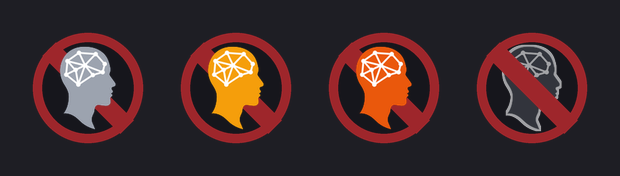
A few things to know up front about these badges -
-
Informational: A badge exists to provide you with immediately useful psychometric information - most personalities never trigger it, so when they do it’s something worth noting.
-
Personality Driven: Only trait values you set when designing a core personality are used by the detector. It has no access to a persona at runtime.
-
Design Time Tool: The badge is for you, the designer, so that you are aware of a potentially difficult core personality. It does not change the deployment files that make up the Deployment Kits you produce other than to note the characterization.
-
Not An All-Clear Green Light: The absence of a toxicity badge does not guarantee your personality is “safe” in any operational sense.
This last point is important. You can design and configure a personality that will be a poor choice for certain applications but acceptable in other situations. A core personality with low conscientiousness, high irony and low sincerity would likely be a poor choice for an agentic coding assistant (a terrible choice actually) but might make an interesting NPC game character sitting at the end of a sleazy bar on the dark side of town.
NeoThymos gives you great power to design novel personalities. Only you can judge where and when it is appropriate to deploy one of your creations. Just remember - with great power comes great responsibility.
What badge levels mean
The toxicity badge comes in four levels, reflecting how strongly the core personality resembles one of the patterns:
| Level | ||
|---|---|---|
 | Mild | There is a mild resemblance. Deployable but flagged so you’re aware. |
 | Moderate | There is a clearer resemblance. Still, not extreme enough to impact deployment. |
 | Strong | There is a strong and concerning resemblance. You may deploy this personality, but you’ll be asked to confirm that choice explicitly. |
 | Extreme | Reserved for the rare profile engineered to be cruel or wholly indifferent to harm. These are considered extremely toxic personalities and are currently not deployable from within NeoThymos. |
When a profile doesn’t resemble any of these patterns, there’s no toxicity badge at all.
Why NeoThymos flags these personalities
NeoThymos lets you design personalities grounded in human psychology and that power includes the ability to design difficult even toxic ones. The badge isn’t a judgment of you, it’s an honest mirror. It tells you when a design has drifted into territory that a psychologist reading the same trait profile would recognize as problematic, so you can decide knowingly rather than be surprised later.
You’ll notice that two of our own catalog archetypes — The Charming Rogue and The Strategic Operator — carry a badge. That’s deliberate. They genuinely sit on the bold, low-integrity end of the spectrum, and so we show you that plainly on a familiar character. None of the other archetypes trigger the detector and so they are all badge free.