Learn
The Vocabulary of Synthetic Personalities
A collection of terms used inside of NeoThymos as well as terminology related to the psychology of personality, emotion and moral reasoning.
To speak clearly about the components and processes of the NeoThymos system we use specific terminology. For information about the NeoThymos user interface consult the help system within the application.
Below are the core concepts you should understand as you read more about synthetic personalities and begin to interact with the NeoThymos system. You can browse the full glossary of terms here.
Personality
The stable structural core of a character: the scaffold of traits that define what it is like to be a particular type of character and carries no name or identity of its own. A discussion of the model of personality used by NeoThymos can be found here.
Synthetic Personality
(aka NT Personality)
A personality that, rather than belonging to a specific human, has been deliberately engineered to represent and mimic a human personality for use in domains such as; AI agent design & configuration, literary story telling, video/cinematic story telling, video game NPG design, table game design & implementation and embodied AI agents (humanoid and toy robots).
Personalities designed in NeoThymos are said to be Synthetic Personalities. They are engineered to be Grounded, Synthetic and Portable, and are often simply referred to as NT Personalities.
Core Personality
Inside of NeoThymos the traits of every personality are based on the HEXACO model of personality - 6 domains containing 25 facets. The model is a result of extensive psychometric and linguistic research into human personality (see the link). Specifically, it represents these traits as a 25 dimension vector, , aka Core Personality Vector (CPV) or core personality and uses this vector to derive a personality profile containing emotional and moral reasoning components that all together contribute to the expression of a character’s persona.
Identity
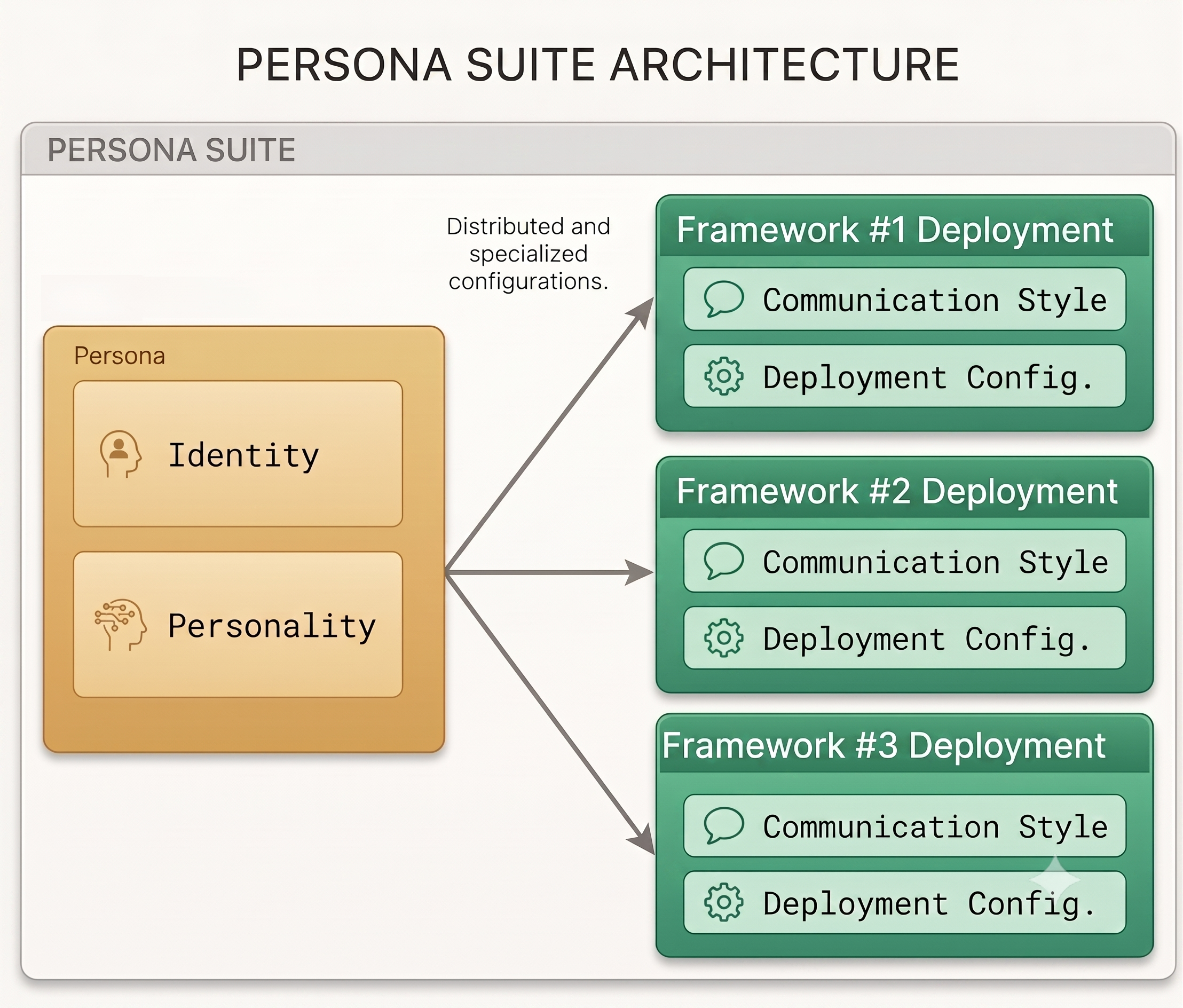
The outward, human-facing attributes attached to a personality — most centrally the character’s name — configured in the Identity Editor. It establishes who the character is, as distinct from what they are like.
Persona
A specific named character: one Personality paired with one Identity. This is the unit a user designs, locks, deploys, and stores in the Library.
Deployment
A configuration of how a Persona is delivered to a production environment (target framework, detail level, communication-style set points, kit-piece selection), producing the framework-specific files that run there (its Kit). It shapes the delivery, not the character — a Persona may have several Deployments, one per target agentic environment.
Kit
(aka NT Persona Kit)
The set of all files output each deployment. This includes; framework-specific files - the concrete, runnable output a user downloads and adds to a production environment plus other documentation such as usage instructions, Character Study PDF, Personality Specification. Each Deployment yields one Kit.
Persona Suite
(aka NT Personality)
A Persona along with all the Deployments (one per deployment framework) created for it: the complete expression of one character across every target it’s been prepared for.
Character Study
The primary human readable product synthesized for the persona from its identity and core personality. A Character Study is a prose exposition of a synthetic personality: it’s temperament, emotional weather, moral center, how they relate, decide, fail, and communicate. It is a component of the full NT Persona Kit intended for the human reader to understand the full implications of their personality design. It can be re-synthesized a limited number of times as the personality is iterative “tuned” before being frozen once the Persona is locked. The final version can be output as a PDF and includes appendices containing the full design specification of the Core Personality and tuned Communication Style.