Learn
Should We Anthropomorphize Our Machines?
Arguements for and against anthropomorphizing machines are both well founded but miss the common ground. As capabilities of AI backed systems grow the arguements converge, we will almost certainly want and need engineered, deterministic, synthetic personalities.
The Debate is Real
Until recently, whether machines should act as though they have personalities and feelings was a philosopher’s question. It is now a product specification question, and in a growing number of jurisdictions, a compliance question. As of mid-2026, twelve U.S. states have enacted companion-chatbot statutes requiring periodic reminders that the user is talking to software, mandating crisis-escalation procedures, and in several cases prohibiting a chatbot from claiming sentience to a minor. Legislatures have started regulating machine personality before the industry has agreed on whether machines should have one.
The debate is real, and the arguments on both sides are stronger than their caricatures.
The case against
The strongest objection is not aesthetic. It is that a machine’s apparent character functions as an implicit claim about its competence, and that claim is usually false.

Researchers describe the failure mode as the shift from machines as tools to machines as social actors. The argument goes - give a system a human-shaped body and fluent language, and people will project intent, understanding, and moral awareness onto it whether or not any is present. Emotional charm reads as evidence of judgment. When the system then fails at something basic — misreads a safety boundary, forgets a critical fact — the collapse in trust is disproportionate, because the user was never calibrated to the machine’s actual envelope of capabilities.
Consequences
The consequences compound:
- Miscalibrated trust. Users over-disclose to systems that seem to care and under-question systems that sound confident. People volunteer things to a confidant that they would never type into a form.
- Attachment and manipulation. A system that fosters emotional bonds can be tuned for engagement rather than for the user’s interest, and the commercial incentive to strengthen the bond runs in exactly the wrong direction. Shutdowns and model updates become losses.
- Responsibility diffusion. The more a system reads as an agent, the harder it becomes to say whether the manufacturer, the deployer, or “the AI” is answerable when it causes harm.
- Displacement. Where a machine substitutes for human contact rather than supplementing it — eldercare is the standing example — the convenience of the substitute might quietly erode the contact that was the actual good.
The moral-judgment problem
The objection sharpens when the system does not merely express character but renders verdicts. Agentic systems increasingly evaluate actions against ethical frameworks: refusing requests, flagging content, allocating scarce resources. Anthropomorphic presentation layered on moral evaluation produces a specific and dangerous artifact — the appearance of impartial wisdom.
Three risks are distinctive here. Value lock-in: moral models inherit the cultural skew of their training data, freeze it into code, and apply it to populations that do not share it. False moral authority: a system that sounds thoughtful invites users, and eventually institutions, to outsource conscience to it, eroding the deliberative capacity that ought to be checking it. Accountability gaps: when a system judges an action wrong and acts on that judgment, tracing the error back to a responsible human becomes genuinely hard.
The critique is not that machines cannot apply rules consistently — they can, often better than tired humans. It is that consistency is not authority, and anthropomorphic presentation blurs the two.
The constructive alternative
This position has a design program behind it, not just a prohibition. The calibrated-design school argues for legibility without deception: separate the mechanics of social interaction from the implication of biology.
Google DeepMind’s robotics work is the clearest institutional expression of this stance. It encourages developers to express system state rather than biological affect — “your heart rate exceeds normal parameters and I am escalating to your physician,” not “I’m worried about you.” The first demonstrates care through action; the second simulates it. Reserve the first person for computational and physical acts (“I scheduled the meeting,” “I cannot lift that”), away from verbs implying an inner life. Fail like a machine: “I am unable to parse that request,” not “hmm, I’m confused.” Prefer geometric abstraction to anatomical realism. In this reasoning, two dots that widen to signal attention carry the social cue without the biological implicature. We should build systems that signal intent the way a person does, by turning toward the cup before reaching for it, but do not sigh before picking it up.
The claim is that humanoid morphology is primarily justified by environmental affordance — stairs, door handles, shelves built for human bodies — not by sociality. Natural language exists for task redirection and explainable reasoning, not persona. Behavioral governance comes from written safety constitutions rather than character prompts.
The case for
The counterargument begins with an empirical observation that undercuts the framing of the debate: anthropomorphism is not a feature you choose to ship, it is a state in the mind of the person interacting with the agent, a mental projection onto the product.
Thirty years of work in the Computers Are Social Actors tradition — Nass, Steuer and Tauber’s experiments and Reeves and Nass’s The Media Equation — established that people apply social rules to computers displaying even minimal social cues. They are polite to machines, they reciprocate, they attribute competence and personality, they respond to flattery. These effects persist in participants who know perfectly well they are talking to a machine. Users are not being fooled. Social cognition simply activates, against whatever the interface presents.
If projection happens regardless, declining to specify a system’s character does not produce a neutral machine. It produces a machine whose character is an accident of training data and prompt drift — one nobody designed, nobody reviewed, and nobody can version.
That reframing is what turns personality from decoration into engineering.
Personality is a design surface
An agent built for hospice intake and one built for debt collection should not have the same demeanor. Nor should a cockpit advisory system and a reading tutor. The research is consistent: warmth benefits coaching and eldercare, while restraint and precision serve aviation, clinical, and engineering contexts. Today that difference is achieved by vibes in a prompt, and vibes drift. A specification is how a designer’s intent for a role becomes an engineered artifact rather than a stylistic accident.
Consistency is a usability property
People cannot form accurate expectations of an agent whose manner changes between sessions, and they disengage from one that feels arbitrary. The evidence favors coherence over realism, an agent that behaves the same way every time beats one that mimics human nuance more convincingly but less predictably.
Specified character is auditable character
A specification can be reviewed, versioned, diffed, and reverted. Behavior emerging from an unstructured prompt cannot be audited when it goes wrong. Two deployments of the same specification behave the same way; two deployments of the same vibe do not.
Affect is an interface for internal state
This is the strongest technical argument. In biological systems, affect is a high-bandwidth broadcast of internal state. In an artificial system, dynamic affect can serve the same role — a rendering layer mapping appraisal variables onto observable behavior. High uncertainty renders as caution and clarifying questions. Goal conflict renders as an acknowledged trade-off. A hard safety constraint renders as a firm refusal. When those signals are groundeEmotd in system telemetry rather than scripted charm, affect stops being a false advertisement of competence and becomes an accurate, continuous report of the system’s state. It is a dashboard, not a mask.
The layering is what distinguishes a specified character from a performed one:
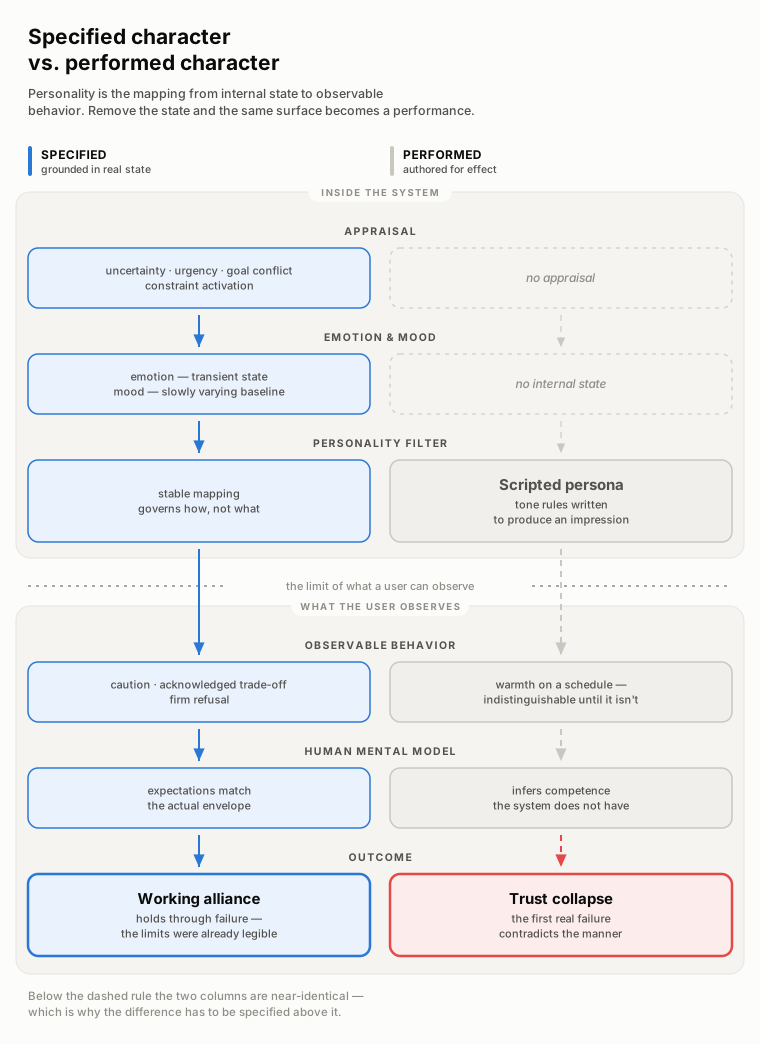
Emotion is transient state. Mood is a slowly varying baseline. Affect is the stable mapping from internal state to observable behavior — it governs how an appraisal is expressed, not what is appraised. Two agents can compute identical appraisals and behave differently because their filters differ: one becomes methodical under pressure, the other terse. That separation is what makes character specifiable independently of capability, and why one architecture can carry different personalities for different deployments.
Appraisal may be constructive, not cosmetic. A further argument holds that emotion-like machinery is useful inside the system, not just at its surface. Rigid utility-maximization planners scale poorly in unstructured environments where goals conflict continuously and the relevant considerations cannot be enumerated in advance. In human cognition, affect functions as a fast meta-cognitive heuristic — prioritizing attention, allocating effort, breaking deadlocks. On this view, what a user perceives as affect is the visible residue of a stateful, value-weighted architecture managing trade-offs in real time. If that is right, the anthropomorphic surface is not a costume over a mechanical core; it is a readout of the core.
Sustained cooperation needs an alliance. Bordin’s working-alliance model — agreement on goals, agreement on tasks, and a bond of trust — has held up across psychotherapy, coaching, education, and now human-AI interaction. Two of its three components are cognitive coordination problems, not friendship. A 2025 integrative review of the digital therapeutic alliance found alliance correlating with engagement and retention: in one CBT-chatbot study 73.8% of participants continued past the first assessment, with the bond subscore rising over time, and alliance scores exceeded bibliotherapy and on some measures approached in-person CBT. The review is candid about the ceiling — clinicians rate bond the weakest dimension, and technical failures damage it quickly. But the direction holds: a technically excellent assistant gets abandoned if people dislike working with it.
The right ambition is not a simulated friend. It is a trusted collaborator — closer to what a good therapist offers a client: reliability, shared goals, memory, and appropriate boundaries rather than intimacy.
Where the disagreement actually lies
If read carefully, the two camps are not arguing about whether machine personality is desirable. They are arguing about timing.
The case against is a case about the present. Its force comes from a gap: users project competence faster than systems earn it. Every named risk — false trust, disillusionment on failure, manipulation, responsibility diffusion — is downstream of that gap. Close it and most of the objections lose their grip. Once a system can reliably do what its manner implies, expressed character stops being an overclaim and becomes an accurate signal.
So the productive question is not should we but what would have to be true first. At minimum:
- Competence parity. The reliability envelope meets what the manner implies. A robot that carries itself as a capable colleague can catch the falling glass, navigate the crowded room, and hold its safety boundaries at the edges.
- Grounded expression. Every expressive signal traces to a real internal variable. Warmth is not scheduled; caution is not decorative.
- Failure legibility. At its limits the system reports its actual mechanism rather than covering the gap with plausible social filler. Confident-sounding failure is the most damaging behavior an expressive agent can exhibit.
- Bounded moral scope. The system applies standards it can name and cite, supplied by an identifiable party, rather than presenting inherited judgments as impartial wisdom.
- Non-exploitative objectives. Character is optimized for the user’s stated goals, not time-on-task. Attachment is a side effect to be managed, never a metric to maximize.
Note how much of the calibrated-design program survives this list intact. Transparent failure states, expression tied to system state, intent signaling without biological mimicry — these are less concessions to the critics than the specification the critics were describing all along. The disagreement is narrower than it looks: it is mostly about whether the deliberate absence of specified character is a safer default than a specified character built to these constraints.
The NeoThymos position
Our position is that anthropomorphic expectation is not a design choice available to us as developers. Users of capable agentic assistants or embodied humanoid robots will expect personality and emotional responsiveness, and they will infer both from whatever behavior they observe. The only question is whether that character is specified or accidental, transparent or opaque, engineered or improvised.
We believe the right moment to enable full expressive character is when capability has advanced far enough that expression no longer overstates competence. For disembodied AI agents this decision is upon us as developers today. Agents are being designed and deployed now. The argument for an engineered, psychologically grounded solution has been made.
For household robots that moment is not yet here. But the right moment to start building is now, because the artifact the industry will need on that day — a psychologically grounded, human-readable, versionable specification of character, reviewable before deployment and auditable after an incident takes time to get right and will be difficult to retrofit onto systems shipped with vibes. Accidental character cannot be diffed against an intended baseline, because there is no baseline.
Three guideposts
Today’s NeoThymos personalities are static configuration components, engineered vectors deterministically interpreted within the context of well defined models, models grounded in the psychology of human personality, emotion and moral reasoning. For example, NeoThymos uses the HEXACO Model of personality to represent a persona’s Core Personality. Other psychological models, for emotion and moral reasoning are used internally.
The components are delivered to the developer as static text files and/or JSON files that can be integrated into an agent’s prompt stream through the configuration of an agent runtime environment. As such it does not currently satisfy the goal of providing an interface to internal state mentioned in the earlier diagram (see item #2 below). So far we can engineer static synthetic personalities, they are not yet dynamic. This is the beginning.
NeoThymos synthetic personalities were conceived from the start as part of a larger group of dynamic system modules collectively referred to as the Emotion Engine. Future NeoThymos products and services are anticipated to provide more dynamic functionality for use by creative storytellers, character authors and developers working with agentic frameworks building personalities for agents and humanoid robots. These may include services for emotion appraisal mechanics, services for emotion state management and even services for moral reasoning. This is what’s needed to fulfill the vision described in the earlier diagram of behavior grounded in internal state.
So, as we move into a world occupied by embodied agents (robots) that incorporate these kinds of social and emotional surfaces for users to interact with, this discussion provides some guideposts that we believe can not be ignored.
- The specification is the product, and it is human-readable. A deployer who cannot read what they are installing cannot be accountable for it, and accountability that cannot be located is the failure mode that worries the critics most.
- Expression grounded in state, not scripted for effect. A character layer that renders real appraisal variables is legible. One that performs warmth on a schedule is deceptive — and that is another thing the critics are right about.
- The deploying developer owns the “ought.” A personality system is a tool, not a repository of moral truth. Whoever ships the agent supplies its moral standards, declares their provenance, and answers for them. A vendor quietly supplying the ethics along with the demeanor would be manufacturing exactly the false moral authority the critics warn about.
Whether machines should be anthropomorphized is, at this point, close to moot. They will be, by the people using them. The open question is whether the industry meets that with engineering or with improvisation.