Learn
Why Use Portraits In NeoThymos?
Portraits serve a useful purpose. They are visual index keys into your gallery and library, not direct claims about a persona's character. Developers who prefer abstraction can substitute the personality knot sigil in settings.
Are portraits unnecessary baggage?
Portraits may seem like a distraction or worse. The concern about anthropomorphizing our AI agents is always a potential objection but here we are working inside a synthetic personality management system and the argument for personality has already been made. Still, they can feel uncomfortable or even a bit misleading if they do not align with an author’s personal expectations - but they are there for a reason.
NeoThymos builds personality from a 25-dimension vector and renders it as a psychologically grounded character persona and ultimately, deployable text. A picture of a face or character contributes little to any of that. Worse, attaching a face to a personality may invite a user to infer that character can be read simply off of facial features. It cannot. That claim has a name, physiognomy, with two thousand years of failure behind it.
The case for portraits is made on entirely different ground. The portrait does not tell you what a persona is. It tells you which persona it is. That distinction is the whole argument.
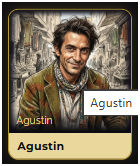
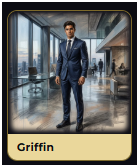
A NeoThymos portrait is derived rather than decorative. Two inputs feed it. The first is the set of physical characteristics you configure in Identity - age, sex, ancestry, and so on. The second is the Personality itself which shapes more subtle choices the image model makes: posture, expression, framing, wardrobe, palette. Edit the vector and the portrait changes with it. The same persona yields a similar portrait.
 |  |  |
|---|
Portraits as visual identifiers
The problem that portraits solve is a library problem, and it is more apparent at scale.
With three personas you need nothing. Names are enough. With thirty, opening the library becomes a retrieval task, and names turn out to be a weak cue for it. Tom, Dick, and Mary are perfectly good names that will cost you a second of hesitation every single time your eye searches for a particular persona.
Four things make an image the better cue.
Pictures are remembered better than words. This is one of the most replicated findings in memory research, going back to Paivio’s dual-coding account: a picture is encoded twice, once as an image and once as the label the mind generates for it, while a word is encoded once. The result is not marginal. Research (Shepard, 1967) showed recognition accuracy near 97% for pictures against 88% for words.
A card grid is a recognition surface, and recognition is cheap. Recognition-over-recall is among the oldest heuristics in interface design, and the reasoning is straightforward: retrieving an item from memory unaided is expensive and error-prone, while confirming a match against something already on screen is fast and nearly free. A library of text-only cards forces recall — you must reconstruct which persona Tom was before you can act. A library of portraits offers recognition instead.
Faces get dedicated hardware. The human visual cortex devotes specialized regions, notably the fusiform face area, to do face processing, and identity recognition from a face happens within a few hundred milliseconds. Whatever one thinks of faces as evidence, they are unmatched as labels. Nothing else you could put on a card is processed as quickly or held as reliably. Evolution has seen to that.
This is an established pattern, not a novelty. Identicons exist for precisely this reason. Don Park proposed them in 2007 after observing that too much of what we read online is text and numbers that are hard to tell apart at a glance once they are jumbled together, and that visual identifiers would fix it. The NeoThymos personality knot belongs to this family. A portrait is the same idea with considerably more perceptual bandwidth behind it.
Finally, variance matters. In building portraits into NeoThymos, variance was a design constraint rather than a benefit.
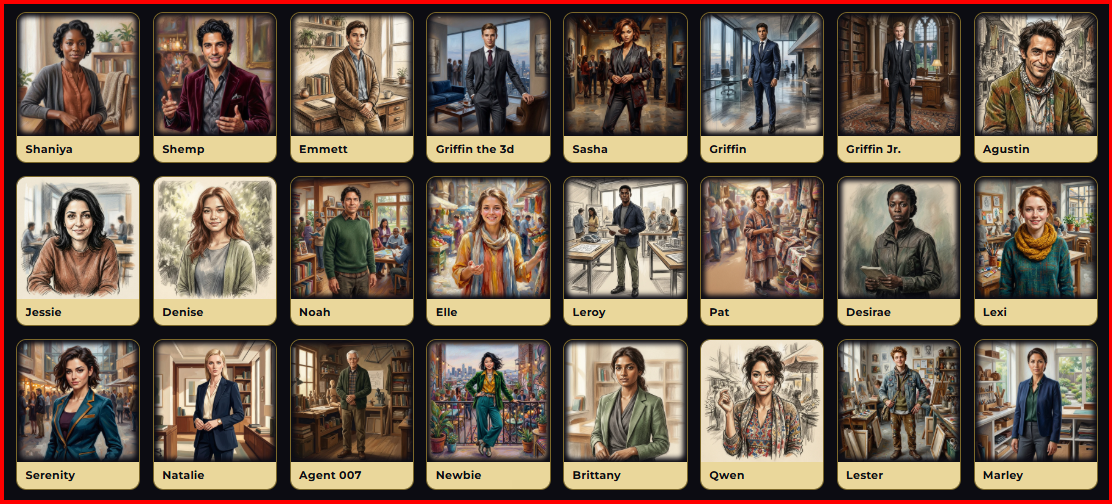
A library of two dozen portraits rendered in one framing, one lighting setup and one aesthetic will index worse than thirty that vary. Image generation in this case has to preserve variance, not just quality. In NeoThymos users can choose to use a single style for all portraits (there is a setting for that) but changing it up helps with visual indexing.
The portrait is not the personality
Everything above justifies a picture. None of it justifies reading the picture as a personality. If a NeoThymos portrait were asserting something specific about its persona’s character, it would be asserting something false.
It isn’t. What the Personality contributes to the image is depiction, not physiognomy.
The portrait speaks through what an actor could show you — expression, bearing, wardrobe, a room — never through what you might read into a head shot’s face or implied bone structure.
When a high-Extraversion persona comes back open-postured and warmly lit, a learned visual convention has been applied — the same convention absorbed from a lifetime of storybooks, film, portraiture and iconography. The portrait speaks through what an actor could show you; expression, bearing, wardrobe, a room - never through what you might read into a head shot’s face or implied bone structure. (Note that this same convention was absorbed by the image model from the same corpus!)
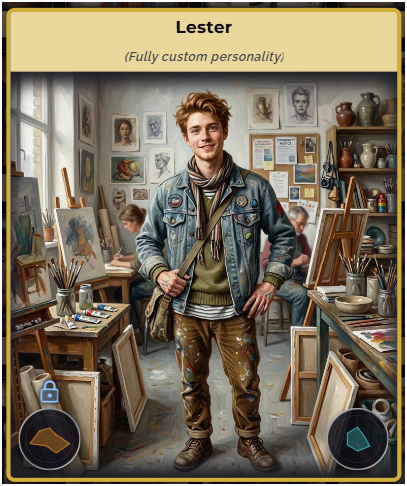
That is exactly the right approach for an index key. Legible enough to be memorable. Not authoritative enough to be overly trusted.
The practical rule for users is this: read the portrait as a book cover, not as a definitive synopsis of the book.
“That’s not how I pictured them”
Some users will see a portrait generated during persona synthesis, look at it, and reject it. This is predictable and the reaction is far older than the technology. One modern example - once you have seen a film based on a book, its casting has a way of becoming the permanent casting of the book in your head. Similarly, a supplied image does not sit politely alongside an imagined one. It competes with it, and it often wins.
If you built a detailed mental picture of your persona before synthesizing it, the portrait will collide with it, and no amount of regeneration is guaranteed to close the gap. That is a real cost. Regenerate the portrait if it helps, we give you that choice. Switch to sigils if it doesn’t.
If you didn’t have a mental model in advance, and a substantial number of people don’t, then there is nothing to displace. For those users the portrait is pure addition: a concrete handle where previously there was only a name.
An alternative to portraits
For those who would prefer not to use portraits, users can replace portraits with a custom identicon of each persona, the personality knot sigil. Choose this option in settings, where you can also choose to make the same substitution on the Character Study for all agents.

The sigil is the more literal identifier of the two. It is hash-keyed and dimension-colored, generated directly from the core personality rather than from an interpretation of it, and it makes no claim it cannot support. If the physiognomy problem is what bothers you, the sigil removes it completely — there is no face to over-read.
The tradeoff is perceptual. Abstract marks do not get dedicated cortical hardware, and telling thirty knots apart is a harder task than telling thirty faces apart. Identicon systems compensate by maximizing structural variation, and the personality knot does the same work through dimension color and topology, but recognition is lower than a face’s.
Neither choice is wrong. One optimizes for retrieval speed, the other for representational fidelity. The app setting exists because that tradeoff belongs to you, the user, not to us.
In short
- The portrait is a label, not a diagnosis.
- Faces index a library better than names do, and better than abstract marks do.
- Neither claim requires the picture to be correct about the persona, only distinctive.
- Personality shapes the image through depiction convention, not through physiognomy.
- Read the portrait as a book cover, not as a definitive synopsis of the book.
- If it doesn’t suit you, switch to sigils in settings.
Sources
- Paivio, A. (1971). Imagery and Verbal Processes. Holt, Rinehart & Winston. — dual-coding account of the picture superiority effect.
- Shepard, R. N. (1967). Recognition memory for words, sentences, and pictures. Journal of Verbal Learning and Verbal Behavior.
- Park, D. (2007). Identicon proposal. — visual identifiers for units of information that are hard to distinguish at a glance.
- Standing, L., Conezio, J., & Haber, R. N. (1970). Perception and memory for pictures. Psychonomic Science.
- Kanwisher, N., et al. (1997) — work on the fusiform face area and face-selective processing. Journal of Neuroscience.